
The College Decision Phase: Navigating Deferrals, Yield Protection, and "The Limbo"
It’s February, and if you have a high school senior at home, your household likely feels like it’s Decision Central. While a small group of students who applied Early Decision are already looking for roommates, the vast majority are stuck in "the limbo"—waiting on regular decision letters, navigating deferrals, and trying to decipher the "business" of college admissions.
In the latest episode of the Positively Healthy Mom podcast, host Laura Ollinger sits down with Jenna Schebell, founder of The College Navigators. With over 20 years of experience as both an admissions officer and a high school counselor, Jenna provides a "dual-lens" perspective on surviving this high-pressure season.
Listen to Part 1 of my conversation with Jenna Schebell, available wherever you get your podcasts now!
The "New Math" of 2026 Admissions
Even though there are fewer high school graduates nationally (the "enrollment cliff"), acceptance rates at popular schools are plummeting. Why?
Jenna points out a major shift: Application Inflation. Students are applying to 15 or more schools out of fear.
In response, colleges are protecting their "yield" (the percentage of students who actually enroll) by adding surprise hurdles. Don't be shocked if your student hits "submit" only to find a new video prompt or an extra essay requirement waiting in their portal. This is the university’s way of asking: "Are you actually coming, or are we just your safety school?"
Strategy Over Status: The Major Trap
A major theme of this conversation is the "Chicken or the Egg" dilemma: Do you choose the school or the major first? Jenna warns that for "direct-admit" programs like Nursing or Engineering, the door often locks after freshman year.
However, she also highlights a common mistake: The Business School Obsession.
“I’ll have students interested in marketing who think they must be in the College of Business. But if they struggle with calculus, they might be much happier (and more successful) in a School of Communication or Liberal Arts. You can still get that same corporate job without the math-heavy business degree.”
Shifting from "Applicant" to "Decision-Maker"
This is a pivotal moment in the process. You’ve spent months (maybe years) trying to be the "perfect candidate," but the power dynamic has officially flipped.
Jenna highlights a critical psychological shift that every family needs to make right now: moving from seeking approval to evaluating fit. You’ve spent the last year in a "Pick me!" mindset, but once those acceptance letters arrive, you are in the driver’s seat. The narrative changes from "Will they want me?" to a confident "Do I want you?" This phase is about more than just prestige; it’s about a cold, hard look at the "big three" fits: social, academic, and financial.
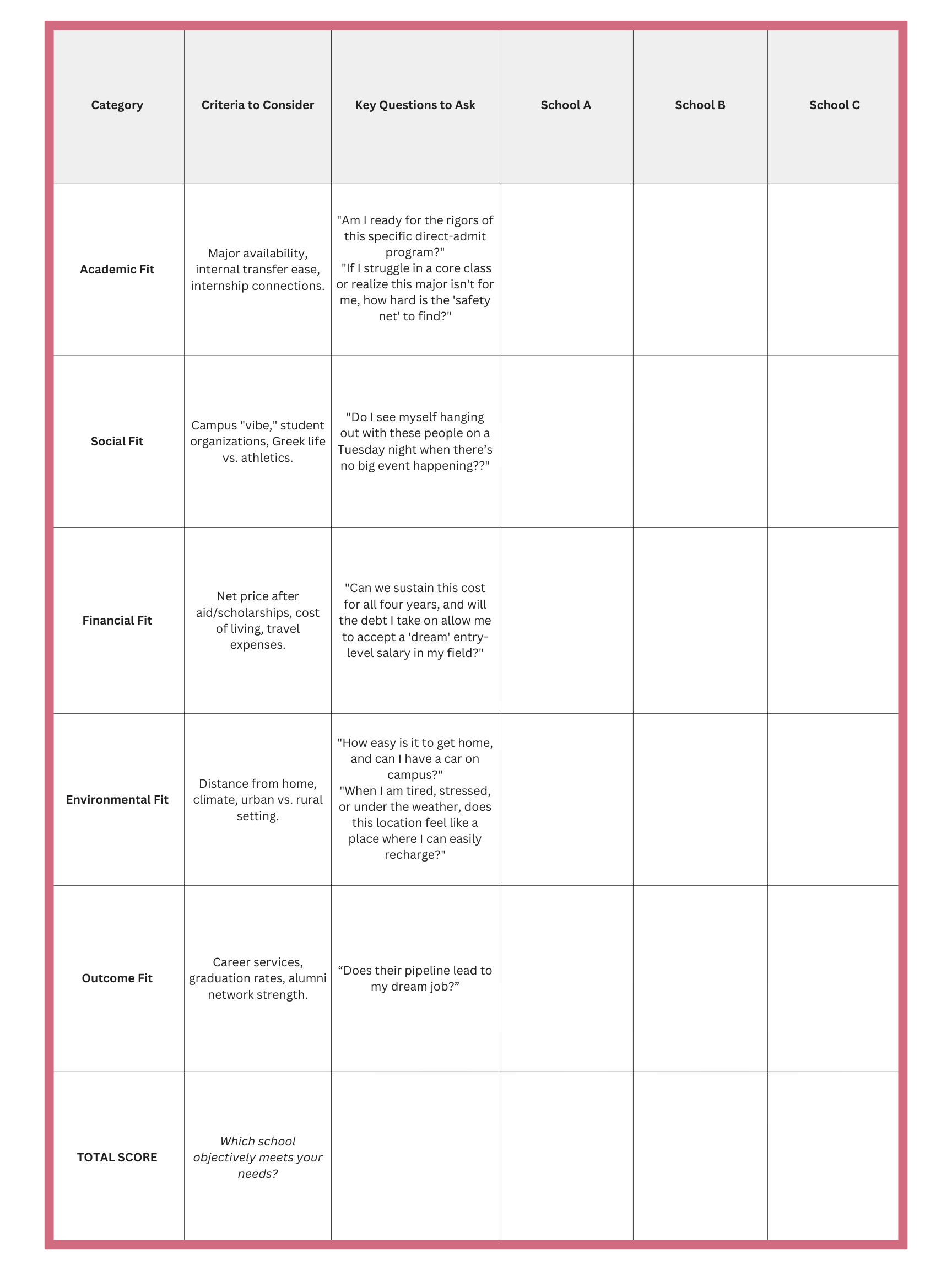
By attending Admitted Student Events and walking the campus not as a tourist, but as a potential resident, students can begin to visualize their daily lives. Are these your people? Does the academic environment feel like a place where you can flourish or just survive? To help you move past "vibes" and into clear-headed analysis, we’ve included a College Decision Rubric below that teens and parents can use together to rank and compare their top choices objectively.
To make that decision even more objective, it helps to move past "brochure talk" and ask questions that reveal the daily reality of the next four years. Here are the "litmus test" questions to help your teen cut through the marketing:
Use this table to move from an emotional "gut feeling" to a balanced decision. Rate each school on a scale of 1–10 for each category.
Finding Your People
Laura and Jenna discuss the heavy emotional weight of this first "adult" decision. Jenna shares a vital reminder for parents: the transition isn't instant. Many students hit a wall in their freshman year, wondering if they chose the wrong school because they haven't found "their people" yet.
College is a fresh start, but finding a community takes time. Whether your student is a "big fish in a small pond" or seeking a massive university challenge, they need the grace to find their way before considering a transfer.
The Decision Phase: Frequently Asked Questions
1. Why was I deferred from my top choice, and what should I do now?
A deferral is often yield protection. Schools may defer high-achieving students to see if they are genuinely interested or to wait for the "Regular Decision" pool.
The Expert Advice: Check your portal. If they allow a Letter of Continued Interest (LOCI) or updated grades, send them. If they say "do not send," respect that—it’s their first test of how well you follow instructions.
2. Can I switch my major to Nursing or Engineering after I get to campus?
Proceed with extreme caution. Programs like these (and the Kelly School of Business at Indiana) have incredibly high thresholds for internal transfers. Jenna suggests that if you are on the fence, start in the harder major. It is much easier to leave Nursing for Education than it is to try to transfer into Nursing later.
3. Is attending an Admitted Students Day worth the trip?
Absolutely. Tours are for applicants; these days are for decision-makers. Schools often separate parents and students so teens can experience simulation labs, eat in the dining halls, and do a "vibe check" with potential roommates. This is where teens can decide if the campus has the potential to feel like "home".
4. What if a college offers me "Summer Admission" instead of Fall?
Jenna notes that summer-start students often have the easiest transitions. They bond in a smaller cohort, get their bearings before the campus gets crowded, and start the fall semester with a solid group of friends already in place.
5. Why are acceptance rates dropping so significantly right now?
It’s a cycle of anxiety. Students apply to more schools, which lowers the admit rates, which makes the next year’s students apply to even more schools. This "application inflation" means colleges are using portals to track "demonstrated interest" more than ever before.
What’s Next?
The college journey doesn't end with the acceptance letter. Next week we continue this deep dive with Jenna Schebell. Tune in for Part 2 of this conversation, releasing on Wednesday, February 25th!
Resources Mentioned in This Episode
Want personalized help navigating your teen’s path? Connect with Jenna Schebell at The College Navigators or reach out to Laura Ollinger at Positively Healthy Coaching for teen and parent well-being support.